What Does OVA Mean in Anime? OVA vs. ONA Explained
By Mika Sato
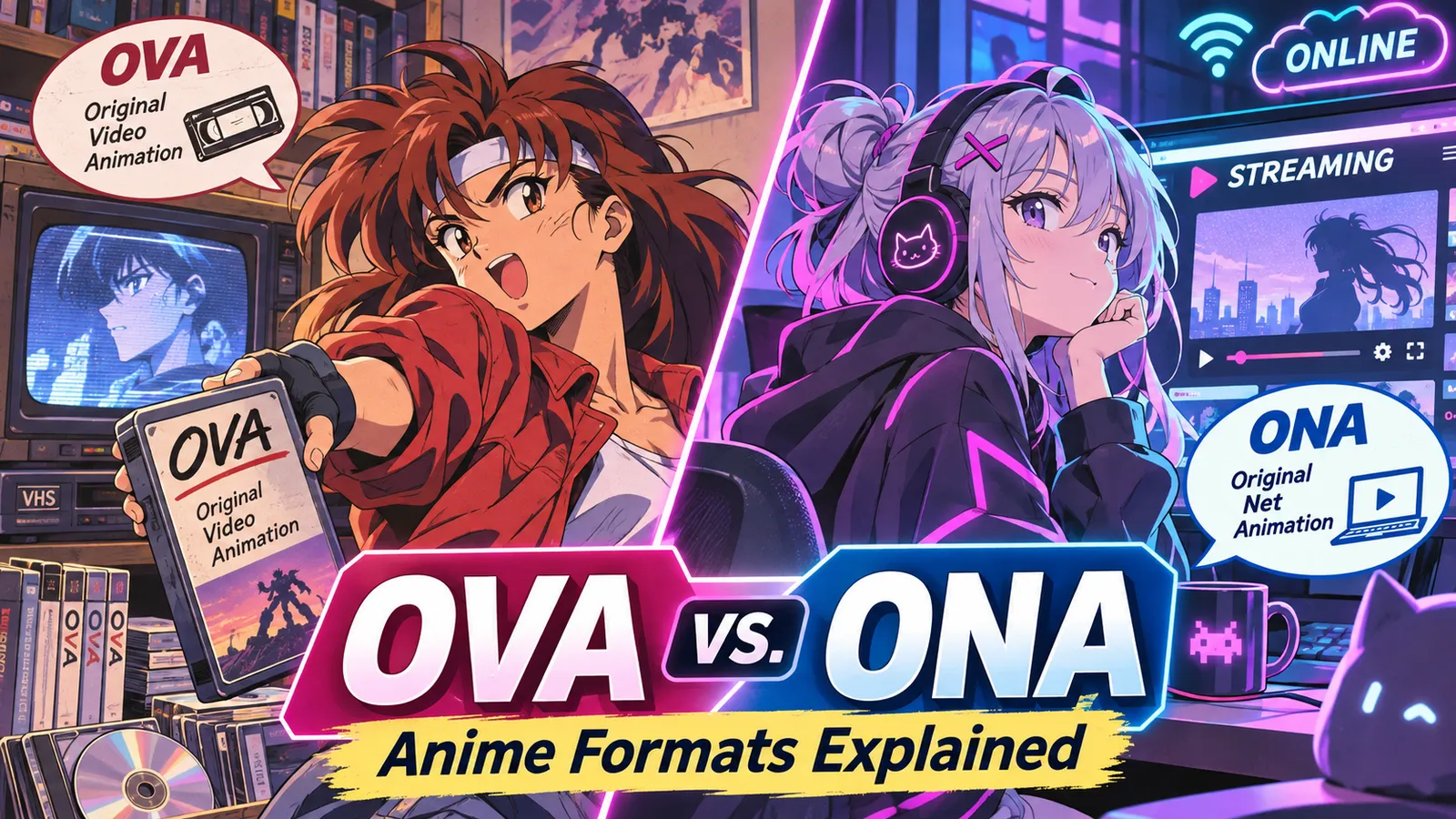
If you've ever finished an anime season and discovered an extra episode labeled OVA, you're probably wondering what that means. Is it a sequel? A filler episode? Something you're supposed to watch before season two?
Then there's ONA, another abbreviation that looks almost identical but means something different. The good news is that neither term is as complicated as it sounds.
OVA stands for Original Video Animation, while ONA stands for Original Net Animation. Both describe how an anime was originally released, not whether it's part of the main story or worth watching.
Here's how to tell them apart—and how to decide whether those mysterious bonus episodes deserve a spot on your watchlist.
What Does OVA Mean in Anime?
An OVA (Original Video Animation) is anime produced for an initial home-video release rather than a regular television broadcast or theatrical premiere. In the VHS era, fans could buy or rent these releases on tape. Later, OVAs appeared on LaserDisc, DVD, and Blu-ray.
That freedom from television scheduling made OVAs a fascinating part of anime history. Some were ambitious standalone productions; others were short extras created for fans of a popular TV series. They might explore a character's past, adapt a manga chapter the show skipped, deliver a goofy comedy adventure, or tell an entirely new story.
Importantly, “original” doesn't mean the plot has to be anime-original. An OVA can adapt an existing manga, light novel, or game. The term describes the intended release format.
A great example is FLCL (2000). Its original six-episode run was released as an OVA, yet it's a complete, wildly inventive anime experience—not a disposable collection of bonus scenes. Its surreal coming-of-age story remains proof that an OVA can be the main attraction.

What Does ONA Mean in Anime?
An ONA (Original Net Animation) is an anime that premiered online, through a website, app, or streaming service, rather than debuting as a traditional television broadcast or physical home-video release.
Early ONAs often consisted of short web episodes or promotional projects. But as streaming grew, online-first anime expanded into major, full-length productions. An ONA today can be a brief comedy, a multi-episode action series, or a self-contained story with the scope of a traditional TV anime.
Take Cyberpunk: Edgerunners (2022). Studio Trigger's ten-episode series premiered on Netflix, making it an easy modern example of an online-first anime. Its intense animation and emotionally devastating story also demonstrate that “ONA” does not mean a low-budget web extra.
And just because an ONA starts online doesn't mean it must stay there forever. An online-first series can later receive a television broadcast or home-video edition without changing how it originally debuted.
OVA vs. ONA: What's the Difference?
The simplest way to remember it is this: OVA = video-first; ONA = internet-first.
| Feature | OVA | ONA |
|---|---|---|
| Stands for | Original Video Animation | Original Net Animation |
| Original release | Home video | Internet or streaming |
| Traditional formats | VHS, LaserDisc, DVD, Blu-ray | Websites, apps, streaming services |
| Typical length | Varies | Varies |
| Can be a full series? | Yes | Yes |
| Automatically canon? | No | No |
| Can later appear on streaming? | Yes | Already online-first; may move between platforms |
| Must be watched before the next season? | Depends on the specific story | Depends on the specific story |
The release method is the distinction—not episode count, animation quality, or story importance. A one-episode OVA and a ten-episode ONA can both be essential viewing. Conversely, either format can contain optional side stories.

Are OVAs Canon or Just Filler?
This is the question many anime fans actually want answered, and the truth is: it depends on the individual OVA.
Some OVAs adapt chapters from the original manga, continue plotlines, or reveal details that matter later. Others are playful what-if adventures, beach episodes, holiday specials, or unrelated comedy sketches. None of those possibilities is guaranteed by the OVA label alone.
Likewise, an ONA might be a central entry in a franchise, a separate adaptation, or a promotional spin-off. Its online debut doesn't make it more or less canon.
Before skipping an extra episode, check its synopsis and where it falls in that franchise's recommended watch order. If it contains important story material, you'll want to fit it in at the right point. If it's a standalone comedy bonus, you can usually save it for whenever you feel like spending more time with the characters.
Famous OVA and ONA Examples
The easiest way to understand these formats is to look at anime that actually used them.
FLCL — OVA
The original FLCL is a six-episode OVA series released in Japan beginning in 2000. With its frenetic visuals, bizarre humor, and coming-of-age themes, it shows how the format could give creators room to experiment outside a conventional TV run.
Hellsing Ultimate — OVA
Hellsing Ultimate is a ten-episode OVA adaptation of Kohta Hirano's vampire-action manga. Unlike a simple bonus episode, it's a major retelling that follows the manga more closely than the earlier television anime. Its long-form, violent supernatural battles make it one of the format's standout examples.

Cyberpunk: Edgerunners — ONA
Cyberpunk: Edgerunners debuted on Netflix in 2022 as a complete ten-episode story. Though it takes place in the world of the Cyberpunk 2077 game, you don't need to play the game first to appreciate its characters or central narrative. This is a perfect illustration of how an ONA can be a fully realized anime, not merely online bonus material.
Devilman Crybaby — ONA
Devilman Crybaby (2018) premiered on Netflix as an online-first adaptation of Go Nagai's Devilman. Its distinctive visual direction and uncompromising horror make it another strong example of the modern ONA format.
What About OAD, OAV, and Anime Specials?
Anime terminology doesn't stop at two acronyms. You may also encounter a few related labels:
- OAV (Original Animation Video): Essentially another way to say OVA. The letters are arranged differently, but there's no separate story category to learn.
- OAD (Original Animation DVD): Often used for anime episodes distributed on DVDs bundled with special editions of manga volumes. It's closely related to the broader OVA tradition.
- Special: A general label for an extra episode or unusual presentation. A special might be a television broadcast, disc bonus, web release, recap, or other production; the word alone doesn't specify its original distribution method.
- Movie: Typically describes a feature film, often made for theatrical release. A film that later streams is not automatically an ONA.
These categories can overlap in the way streaming services organize their libraries. A platform may put OVAs, TV specials, and other extras under the same menu even though their original release histories differ.
Do You Need to Watch OVAs Before Starting the Next Season?
Not necessarily. An OVA's position in the story matters much more than the letters in its title.
If you're following a long-running anime, this is a practical approach:
- Finish the current season, unless a trustworthy watch-order guide specifically places an extra between episodes.
- Check what the OVA covers. Is it a continuation, prequel, manga adaptation, comedy extra, or recap?
- Watch story-relevant episodes in chronological or recommended order. Some franchise extras provide useful context for later arcs.
- Save standalone bonuses for later. If the episode is just extra time with characters you like, there's usually no urgency.
The same advice applies to ONAs connected to an existing franchise. A separate online series might be crucial, entirely optional, or a good standalone starting point.
Why Do OVAs Still Matter in the Streaming Era?
Streaming has blurred the difference between formats from the viewer's perspective. You might watch a 1990s OVA, a television series, and a modern ONA on the exact same app. Without looking at their original release histories, they can appear identical.
But the labels still tell you something interesting about anime as a medium. OVAs grew out of a home-video market that allowed studios to experiment with different runtimes, audiences, and storytelling approaches. ONAs reflect the shift toward digital-first distribution, where a series can reach viewers without debuting on a Japanese TV channel.
Neither format is inherently better. In both cases, what matters most is the anime itself.
Frequently Asked Questions About OVAs and ONAs
Is an OVA the same as a filler episode?
No. OVA describes how an anime was released. Filler generally describes material that doesn't advance, or isn't adapted from, a particular source storyline. An OVA can adapt canon manga chapters, and a television episode can be filler.
Are OVAs shorter than regular anime episodes?
Not always. Some OVAs run for only a few minutes, while others have standard-length or extended episodes. There is no fixed OVA runtime.
Is Netflix anime automatically an ONA?
No. An anime streaming on Netflix isn't necessarily an ONA. A show that originally premiered on television remains TV anime even if Netflix distributes it later. The original release method is what counts.
Can an OVA have multiple episodes?
Absolutely. FLCL has six original OVA episodes, while Hellsing Ultimate has ten. An OVA can be a complete series rather than a single bonus installment.
Is an ONA automatically non-canon?
No. An ONA can tell a main storyline, adapt existing source material, or explore an alternate continuity. Check the specific franchise rather than assuming its continuity from the label.
Should beginners skip OVAs?
Not by default. Beginners can skip optional extras if they want to keep their watchlist simple, but some OVAs are outstanding standalone anime or important entries in a franchise. Read a spoiler-free description first.
The Bottom Line: OVA vs. ONA
If you remember one thing, make it this: OVA means an anime originally released for home video; ONA means an anime originally released online. Neither label automatically tells you whether it's canon, filler, short, or worth your time.
When you're deciding what to watch next, look beyond the acronym. The best OVA might be an unforgettable standalone classic like FLCL. The best ONA might be a major streaming production like Cyberpunk: Edgerunners. And that obscure extra episode attached to your favorite show? It could be a hilarious bonus—or a piece of the story you won't want to miss.
Further reading and verification: