What Is an Anime Cour? Seasons and Split-Cours Explained
By Hana Mori
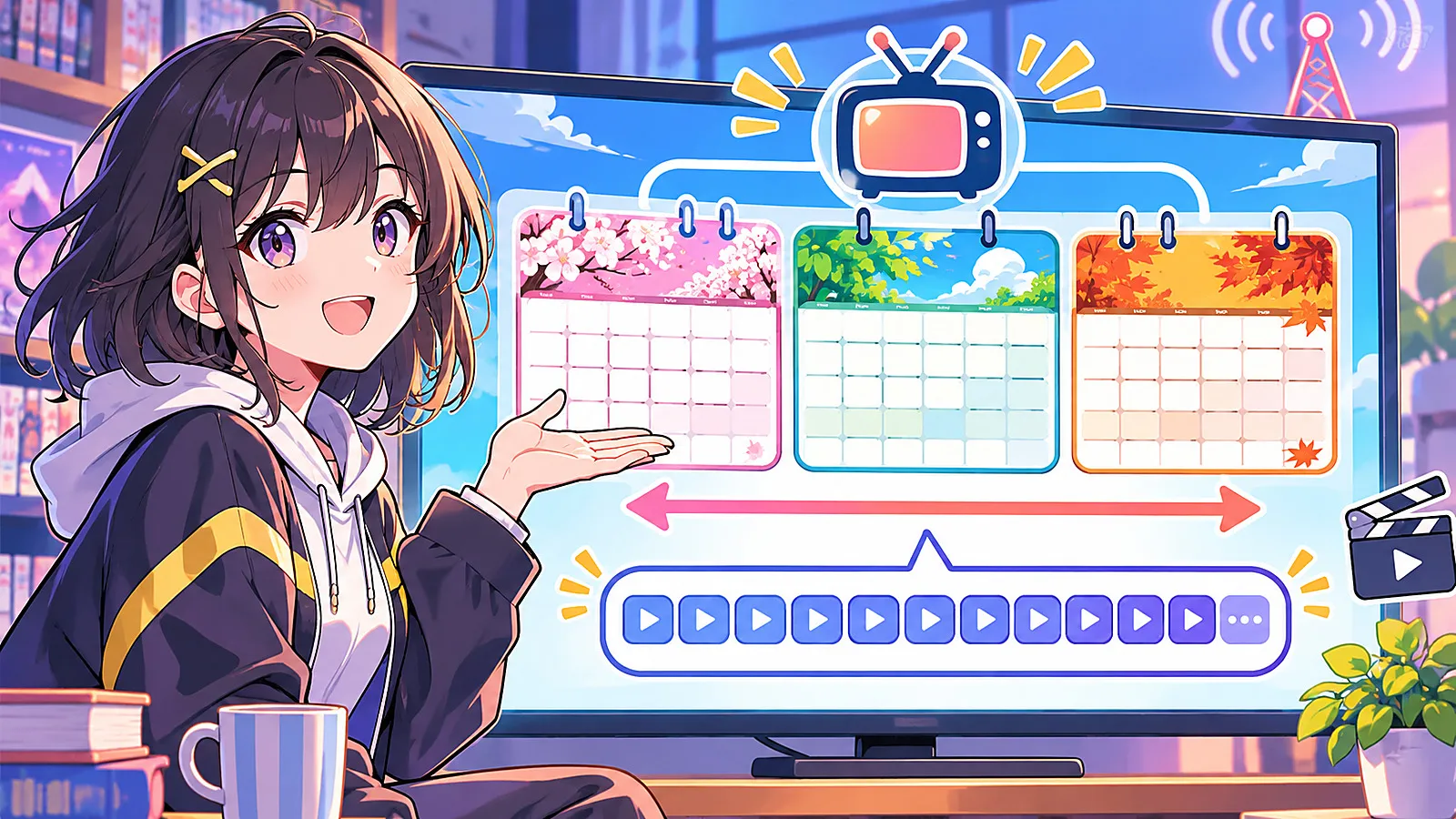
If you've ever looked up an upcoming anime and seen fans celebrating a two-cour adaptation, you might have wondered what that actually means. Is it two seasons? Twenty-four episodes? A sequel that's already confirmed?
Then there's split-cour, a phrase that can make an anime's release schedule sound more complicated than its story. Fortunately, the explanation is simple once you know how Japanese television works.
The short answer: An anime cour (pronounced core) is a television broadcast block lasting roughly three months, usually enough for 10–13 weekly episodes. A season can contain one cour, two consecutive cours, or multiple cours separated by a break.
Here's how to tell them apart—and why the difference matters when you're deciding what to watch.
What Does Cour Mean in Anime?
A cour is a unit of television scheduling rather than a story arc or an official season number. It comes from the Japanese term クール (kūru), commonly traced to the French word cours. In anime discussions, it refers to approximately one quarter of a year.
Japanese TV schedules are organized around four main broadcast periods:
| Anime broadcast season | Typical months |
|---|---|
| Winter | January–March |
| Spring | April–June |
| Summer | July–September |
| Fall | October–December |
Because many TV anime release one new episode each week, a three-month block naturally accommodates around 12 or 13 episodes. That is why a lot of modern anime have an episode count in that range. But a cour is not a promise of exactly 12 episodes: premiere specials, programming interruptions, and production decisions can change the number.
It also explains why announcements often say that a show will premiere in the Spring 2027 anime season rather than giving a specific day months in advance. That label identifies the broader broadcast window.

One-Cour Anime: The Standard Short Season
A one-cour anime normally airs for one three-month broadcast window and has approximately 10–13 episodes. This is a common format for adaptations, original anime, romantic comedies, and seasonal releases.
For example, Bocchi the Rock! aired 12 episodes during Fall 2022. It's a straightforward example of a single-cour season: one weekly run, then the season ends.
A one-cour series doesn't necessarily tell a complete story. Sometimes those episodes adapt only the opening portion of a manga or light novel. Other times, especially with original anime, the whole narrative fits into that run.
For viewers, the benefit is convenience. A 12-episode anime is easy to finish over a weekend, and the shorter commitment makes trying unfamiliar genres less intimidating.
Two-Cour Anime: Roughly Six Months of Episodes
A two-cour anime covers approximately two television quarters, usually landing somewhere around 22–26 episodes, although there are exceptions. The important detail is whether the two cours air back-to-back or with a longer break between them.
In a consecutive two-cour run, the series continues from one broadcast quarter straight into the next. There might be a short holiday or scheduling interruption, but there isn't a whole seasonal gap separating the two halves.
Frieren: Beyond Journey's End is a great example. Its first season aired from September 2023 through March 2024, spanning two consecutive cours and totaling 28 episodes. Even though it crossed from the Fall 2023 anime lineup into Winter 2024, it remained one numbered season of the show.
That extra time can give an adaptation room for more character development, longer story arcs, and less pressure to fit a large amount of material into a single 12-episode batch. It does not automatically mean a higher budget or better animation, though—those depend on the production itself.
What Is a Split-Cour Anime?
A split-cour anime is a series planned to air in multiple broadcast blocks with a break between them. Often, it means a roughly 24-episode season divided into two batches of about 12 episodes each.
Imagine a show with this schedule:
| Broadcast period | What happens |
|---|---|
| Spring | Episodes 1–12 air |
| Summer | The anime goes on hiatus |
| Fall | Episodes 13–24 air |
That is a typical split-cour pattern. Viewers still get two cours of anime, but they don't arrive consecutively.
Spy x Family Season 1 is a particularly clear real-world example. Its first 12 episodes aired in Spring 2022, and its remaining 13 episodes aired in Fall 2022. Despite the months-long gap, those 25 episodes belonged to the same first season, not Season 1 and Season 2.
Why split a season at all? There may be scheduling, broadcast, marketing, or production reasons. A planned gap can give a team more time to finish later episodes, but split-cour does not mean a production is trouble-free and shouldn't be confused with an unexpected delay.

Anime Cour vs. Season vs. Part: What's the Difference?
This is where the terminology gets messy, because the word season can mean at least two different things.
A broadcast season is a calendar period such as Spring 2026. A series season is an installment labeled Season 1, Season 2, and so on. Meanwhile, a part is a subdivision chosen by the publisher or distributor, and it doesn't follow a universal episode-count rule.
| Term | What it tells you | Typical length |
|---|---|---|
| Cour | A broadcast block | About 3 months |
| One-cour season | One block of a series | Usually 10–13 episodes |
| Two-cour season | Two blocks of a series | Often 22–26 episodes |
| Split-cour | Multiple blocks with a scheduled gap | Often two batches of roughly 12 episodes |
| Season 2 | A newly labeled installment | No fixed length |
| Part 2 | A labeled continuation or subdivision | No fixed length |
So when someone announces Season 2, Part 2, you should not assume that it's Season 3. Likewise, a second cour is not automatically a second season.
Streaming platforms sometimes group episodes differently from anime databases. Even TheTVDB's guidance on split-cour anime notes that a split release can be treated as a single season despite the gap. When the labels disagree, compare the official episode numbers and release dates rather than relying only on the season dropdown.
Does a Split-Cour Mean the Anime Was Renewed?
Not necessarily. If both cours were announced as parts of the same production, the second block is generally a planned continuation—not a surprise renewal caused by the success of the first half.
That's an important distinction when anime headlines start circulating. The announcement of a split-cour second half is exciting, but it doesn't tell you whether the show has secured an additional season beyond those already scheduled episodes.
If you're trying to figure out whether more story is coming, look for official wording such as new season, sequel production confirmed, second cour, or Part 2. Those announcements can describe very different things.
Why Do So Many Anime Have 12 or 13 Episodes?
There is no secret storytelling formula that makes episode 12 the perfect stopping point. The explanation is largely practical: one cour fits into the Japanese quarterly TV schedule.
A 12-episode run also lets producers develop a finite block of episodes rather than immediately committing to a year of weekly television. For manga and light novel adaptations, that can provide a natural place to pause and assess what comes next.
However, the familiar 12-episode format isn't universal. Some shows run for 10 or 11 episodes; others have extended premieres, unusual broadcast schedules, or totals above the typical range. A cour is a useful estimate, not an ironclad rule.
Can an Anime Have Three or Four Cours?
Absolutely. A three-cour run covers approximately nine months, while a four-cour run covers roughly a full year of television. These labels describe duration, not the number of story arcs.
Long-running anime may extend far beyond four cours, sometimes airing nearly every week for years. Conversely, streaming originals and anime released all at once may not fit neatly into the traditional broadcast calendar at all.
So if you're comparing a long-running classic with a modern seasonal adaptation, don't assume the same terminology will describe their releases in precisely the same way.

How Can You Tell Whether an Anime Is Split-Cour?
Look at the official release announcement first. If it says split two-cour, second cour scheduled for October, or identifies two distinct broadcast windows with a planned break, that is your strongest clue.
You can also check the episode schedule. If a show aired 12 episodes in spring, stopped through summer, and resumed episode numbering in fall, there's a good chance you're looking at a split-cour release. Just remember that a delayed show can look similar on a calendar; the planned nature of the break matters.
When in doubt, check the anime's official site, a broadcaster announcement, or a reliable episode guide before calling the return a brand-new season.
Frequently Asked Questions About Anime Cours
How do you pronounce “cour” in anime?
It's generally pronounced “core.” The Japanese term is kūru (クール).
How many episodes are in one cour?
Usually 10–13, with 12 or 13 being especially common. Exact counts vary.
Is two-cour the same as two seasons?
No. Two cours describe approximately six months' worth of TV scheduling. They might both belong to one numbered season.
Is a split-cour the same as a hiatus?
A split-cour includes a planned break between broadcast blocks. “Hiatus” is a broader term that can also describe unexpected or indefinite pauses.
Does Part 2 always mean the second cour?
No. It's often used that way, but Part 2 is a naming choice, not a strict scheduling definition.
Can a 24-episode anime be one season?
Yes. A season can contain two consecutive cours or two split cours and still be labeled Season 1.
The Bottom Line: Cour Tells You When Anime Airs, Not What Season It Is
The simplest way to remember it is this: a cour is a broadcast block; a season is a label for part of a series. A one-cour anime usually runs for roughly three months. A consecutive two-cour anime continues across about six months. A split-cour anime breaks that longer run into separate release windows.
Once you understand that distinction, confusing announcements like Season 2 Part 2 or the second cour begins this fall become a lot easier to decode. And the next time your favorite anime disappears after episode 12, you'll know the first question to ask: is the story getting a new season, or is its next cour already on the schedule?